
7 Free English Shadowing Websites Worth Using
There are plenty of English shadowing websites, but few give you clean audio, sentence-by-sentence replay and feedback on what you actually said. This guide compares the 7 best free options in 2026, from a shadowing tool that scores every word you speak to classic sources like BBC Learning English, TED-Ed and VOA, with advice on which to use for your level and a 15-minute daily routine.
What makes a good English shadowing website?
Shadowing means listening to a sentence from a native speaker and repeating it right away, copying the pronunciation, stress and intonation. The method is simple, but doing it with an ordinary YouTube video is tedious: you pause, rewind to the right sentence, record yourself and guess what you got wrong. Before the list, here are the five criteria we used to judge each site:
- Clear audio and natural voices. Real people, recorded cleanly; synthetic voices will not teach you intonation.
- An accurate transcript or subtitles, so you know exactly what was said before you repeat it.
- Sentence-by-sentence replay. Shadowing works best when you loop one sentence several times, not the whole clip.
- Pronunciation feedback. Recording yourself and comparing with the model sentence shows dropped endings, misread words and wrong pauses.
- A range of levels and topics, from slow English for beginners to natural-speed talks and TOEIC or IELTS style audio.
Most well-known free sources only meet the first two. If you are new to the method, read how to practice English shadowing effectively first, then come back and pick a source below.
7 free English shadowing websites at a glance
| Website | Cost | Transcript | Sentence replay | Pronunciation scoring | Best for |
|---|---|---|---|---|---|
| S English | Free to start, Premium available | Yes | Yes | Yes, per word plus AI feedback | All levels, TOEIC, IELTS |
| BBC Learning English | Free | Yes | No | No | A2–B2 |
| TED and TED-Ed | Free | Yes | Partly (interactive transcript) | No | B1 and up |
| VOA Learning English | Free | Yes | No | No | A1–B1 |
| ELLLO | Free | Yes | No | No | A2–C1 |
| British Council LearnEnglish | Free | Yes | No | No | A1–C1 |
| Spotlight English | Free | Yes | No | No | A1–A2 |
1. S English (senglish.net): shadowing with word-by-word scoring
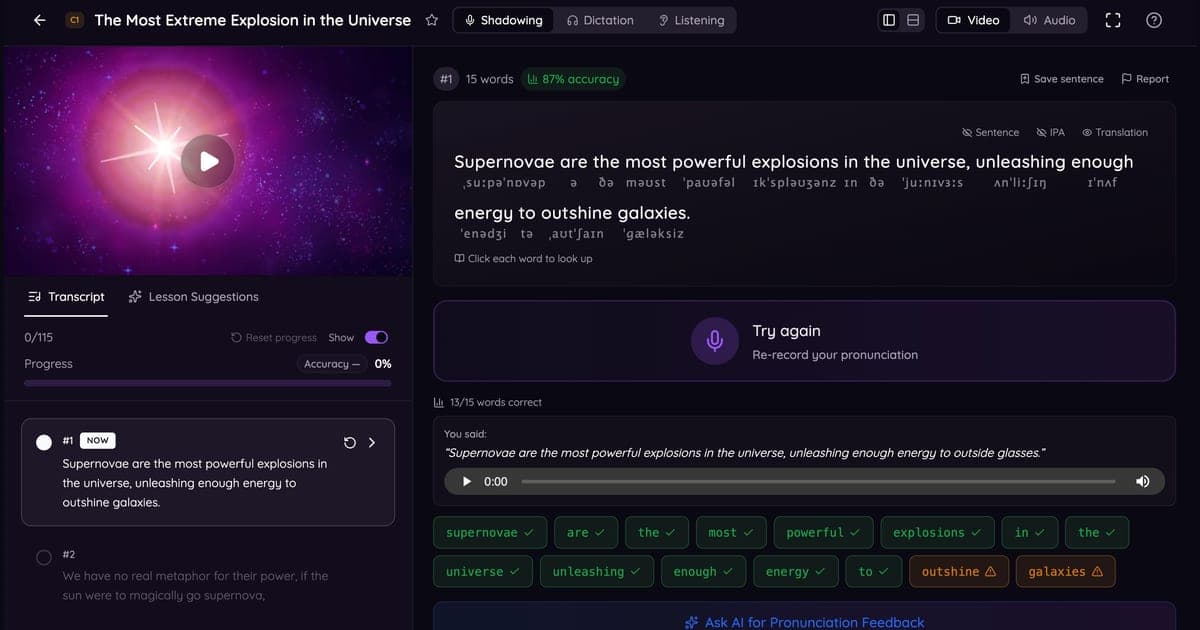
S English (senglish.net) is an English learning app built around shadowing and dictation. Every YouTube video or audio lesson is split into sentences: you listen, tap the microphone, say the sentence, and see straight away which words you got right and which need work. (Disclosure: S English is made by the team writing this article. We put it first because it is the only site in this list that covers listening, speaking, pronunciation scoring and vocabulary review in one place.)
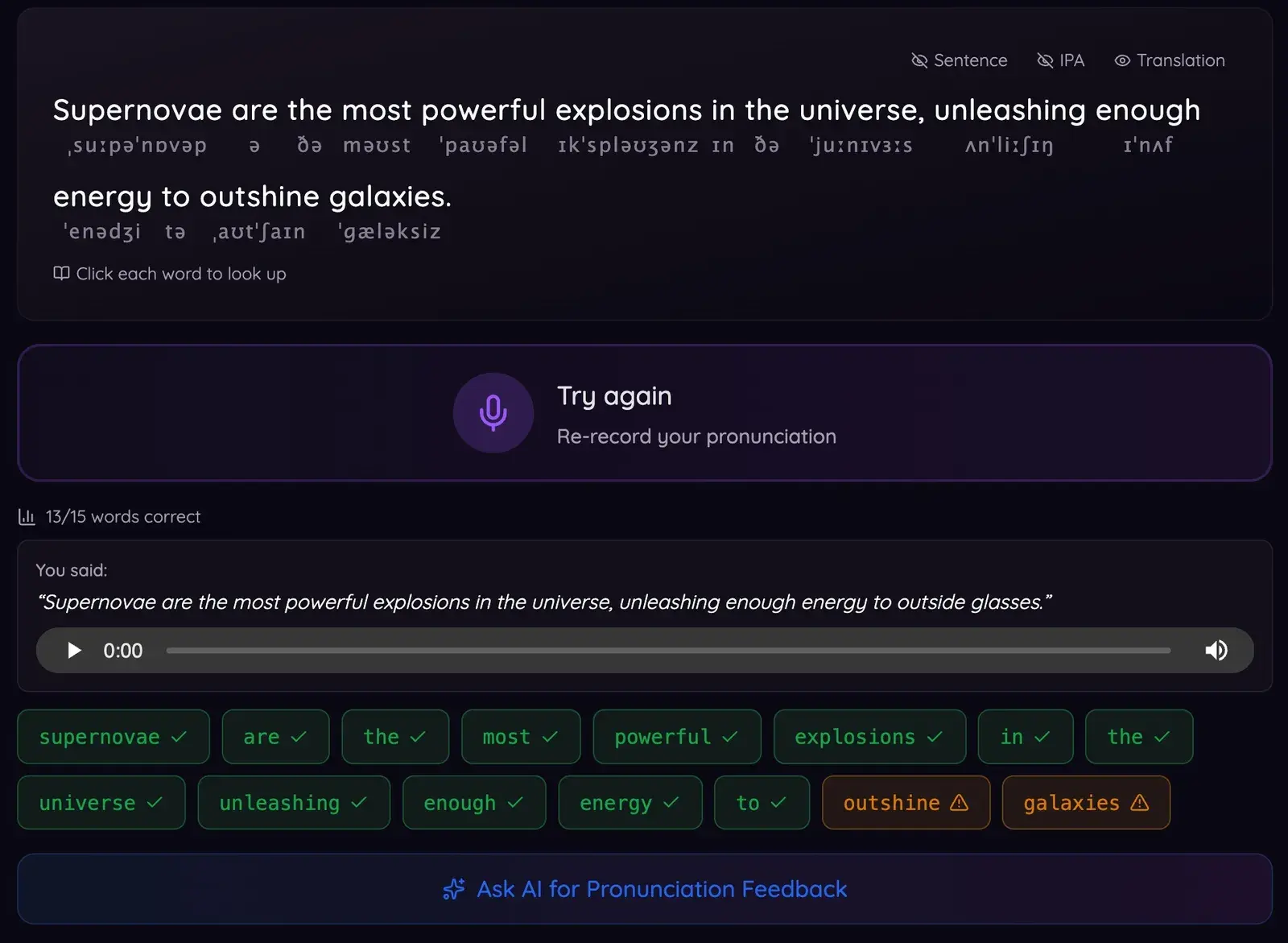
- Word-by-word scoring. After recording, you see what you said, how many words were correct and each word colour-coded: green for correct, orange for words to practise again. You can replay your own recording to compare it with the speaker.
- AI pronunciation feedback. Tap “Ask AI for Pronunciation Feedback” to learn why a word sounded off and how to fix it. The free plan has a monthly limit on AI feedback; Premium is unlimited.
- IPA and translation under the sentence. Turn on IPA to see word stress, turn on the translation when a sentence is unclear, or hide the sentence entirely to train your ear.
- Speed control and sentence merging. Slow playback to 0.5x or 0.75x when a sentence is too fast. If a sentence is too short, merge it with the next one to shadow a longer, more natural stretch.
- Topic and exam library. Hundreds of shadowing lessons across 12 topics, including IELTS (250+), TOEIC (100), daily conversations, business English, job interviews and music, each tagged with a CEFR level.
- Content from BBC, TED and Kurzgesagt. The sources further down this list are available as interactive shadowing lessons: more than 100 BBC Learning English and more than 200 TED lessons.
- Look up, save and review. Tap any word for its meaning and pronunciation, save words or whole sentences, then review them with flashcards using spaced repetition.
- Switch between Shadowing, Dictation and Listening on the same lesson. Transcribe a passage first to hear every word, then shadow it.
- Best for: any level, TOEIC and IELTS learners, and anyone fixing pronunciation without a teacher.
- Limitations: you need an account and microphone access; some lessons and unlimited AI feedback are part of Premium.
2. BBC Learning English: British English intonation
BBC Learning English is the BBC’s free learning site. Its 6 Minute English series (two presenters chatting for about six minutes) suits shadowing well thanks to its moderate pace and full transcripts. There are also short pronunciation series on linking, weak forms and sentence stress.
- Strengths: clear standard British English, topics close to IELTS Speaking and Listening, downloadable transcripts.
- Limitations: no sentence splitting or scoring; you pause the audio yourself and record on your phone.
- Tip: more than 100 BBC Learning English episodes are available as sentence-by-sentence shadowing lessons on S English.
- Best for: A2–B2, learners aiming for a British accent.
3. TED and TED-Ed: shadowing presentation-style speech
TED has thousands of talks with interactive transcripts: click a sentence and the video jumps to it, which makes replaying easy. TED-Ed offers animated lessons of about 4–6 minutes with carefully written, clearly spoken scripts.
- Strengths: learn how speakers stress and pause when presenting; many accents; great for IELTS Speaking Parts 2–3 and work presentations.
- Limitations: TED talks usually run 10–20 minutes at a fast pace, with no recording or scoring. Beginners should start with TED-Ed.
- Best for: B1 and up.
4. VOA Learning English: slow English to speak along with
VOA Learning English reads the news more slowly than normal, with short sentences and a limited vocabulary. Each story has audio or video plus the full text.
- Strengths: clear American English at a pace beginners can follow; transcripts match almost word for word.
- Limitations: the rhythm is slower and flatter than real conversation, so use it early on; no recording tools.
- Best for: A1–B1, first steps in shadowing.
5. ELLLO: natural conversations in many accents
ELLLO has thousands of free recordings, mostly short unscripted conversations between speakers from many countries, each with a transcript, comprehension questions and vocabulary notes.
- Strengths: real-life English with hesitations, linking and casual phrasing; good for conversation practice.
- Limitations: recording quality varies, and overlapping speakers are hard to follow for beginners.
- Best for: A2–C1, sounding more natural in conversation.
6. British Council LearnEnglish: listening by CEFR level
The Listening section of British Council LearnEnglish sorts lessons from A1 to C1. Each is a short situation such as a phone call, meeting or announcement, with a transcript and exercises.
- Strengths: clear levels, exam-like situations, standard British English; easy to pick the right difficulty.
- Limitations: few lessons per level; exercises focus on comprehension, not speaking.
- Best for: shadowing at exactly your CEFR level.
7. Spotlight English: slow, clear audio for beginners
Spotlight English is a radio programme explaining culture, history and science in simple English, read slowly and clearly, with audio and a full transcript for each episode.
- Strengths: very slow and clear, ideal for copying individual sounds and word stress.
- Limitations: much slower than real speech; move on once you are comfortable.
- Best for: A1–A2 beginners.
Which shadowing website should you choose?
- Beginners (A1–A2): copy the slow voices of Spotlight English or VOA, and practise low-level lessons on S English with IPA and translation on and speed at 0.75x.
- IELTS: combine IELTS shadowing lessons on S English with BBC Learning English and TED-Ed to learn how to develop longer answers for Speaking Parts 2–3.
- TOEIC: shadow TOEIC-style announcements and office conversations; repeating them also speeds up your listening.
- Everyday and work English: daily conversation and job interview lessons plus ELLLO, then practise speaking with AI to build your own sentences.
- Upper-intermediate (B2+): shadow TED and Kurzgesagt at 1x with the sentence hidden, revealing it only when stuck.
How to shadow on a website in 15 minutes a day
- Pick a clip at your level, 1–3 minutes long, where you understand about 80%.
- Understand before you speak. If you cannot catch every word yet, transcribe the passage first; see our list of free English dictation websites.
- Repeat sentence by sentence, copying rhythm and intonation, not just individual words.
- Record and compare, focusing on endings (-s, -ed, -t), linking and stressed words.
- Repeat the sentences you missed three to five times until they flow, then move on.
- Save useful sentences and review them a few days later so they become automatic in conversation.
With sites that only offer audio and a transcript, steps 3–5 are manual work with your phone. On S English, splitting, replaying, recording and word-by-word scoring are built in, so the same 15 minutes gets you through more sentences and shows exactly what to fix.
FAQ
Which shadowing website scores pronunciation for free?
S English scores each word after every recording and shows how many words you said correctly; the free plan also includes a monthly allowance of AI pronunciation feedback. Sources like BBC, TED and VOA only provide audio and transcripts, so you record and compare yourself.
Which shadowing website is best for beginners?
Start with slow, short material: Spotlight English, VOA Learning English, or low-level lessons on S English with IPA, translation and 0.75x speed. Once you can keep up easily, move on to BBC Learning English and TED-Ed.
Can I practise shadowing with YouTube videos?
Yes. You can pause videos and repeat sentence by sentence yourself, or use YouTube lessons already split into sentences on S English, from BBC Learning English, TED and Kurzgesagt, with replay, recording and instant scoring.
How long should I practise shadowing each day?
About 15–20 minutes a day is enough if you are consistent. Working carefully through 10–15 sentences and repeating the ones you miss beats shadowing a long clip once.
Does shadowing improve listening too?
Yes. Once you can produce native linking, weak forms and intonation yourself, you recognise them faster when listening. Combining shadowing with dictation improves both skills together.
Practise shadowing for free on S English
Hundreds of BBC, TED, TOEIC and IELTS lessons split into sentences, with IPA, translations and word-by-word pronunciation scoring. Start free.
Start shadowing free