10 Best Free English Dictation Websites with Transcripts
Dictation is one of the most effective ways to train your listening, but the wrong source makes it easy to give up: clips that are too fast, no transcript, and endless pausing to check every word. This guide covers the 10 best free English dictation websites in 2026, from a dictation tool that scores you as you type to classic listening sources like BBC Learning English, TED-Ed and VOA, plus advice on which to pick for your level and goal.
What makes a good English dictation website?
Before the list, here are the 5 criteria we used to judge each site:
- An accurate transcript to check against after listening. Without one you cannot correct yourself.
- Sentence-by-sentence playback with easy replay, instead of dragging the timeline yourself.
- Automatic scoring or matching so you see immediately where you went wrong, and whether you misheard or simply did not know the word.
- Several levels and accents: slow and clear for beginners, natural speed and British, American and Australian voices for test preparation.
- Real content organized by topic: everyday conversations, news, talks, and TOEIC or IELTS-style listening.
Most well-known sites only give you audio and a transcript, so you write on paper and compare. Very few tools handle the splitting and scoring for you, which is why S English is first on this list.
Quick comparison of the 10 dictation websites
| Website | Cost | Transcript | Scores as you type | Best level |
|---|---|---|---|---|
| S English | Free to start, Premium available | Yes | Yes, word by word | All levels, TOEIC, IELTS |
| BBC Learning English | Free | Yes | No | A2–B2 |
| TED and TED-Ed | Free | Yes | No | B1 and above |
| VOA Learning English | Free | Yes | No | A1–B1 |
| Breaking News English | Free | Yes | Yes, basic | A2–B2 |
| ELLLO | Free | Yes | No | A2–C1 |
| British Council LearnEnglish | Free | Yes | No (multiple choice) | A1–C1 |
| Listen A Minute | Free | Yes | Yes, basic | A2–B1 |
| ESL Lab | Partly paid | Many lessons | No | A2–B2 |
| Spotlight English | Free | Yes | No | A1–A2 |
1. S English (senglish.net) – dictation with instant scoring
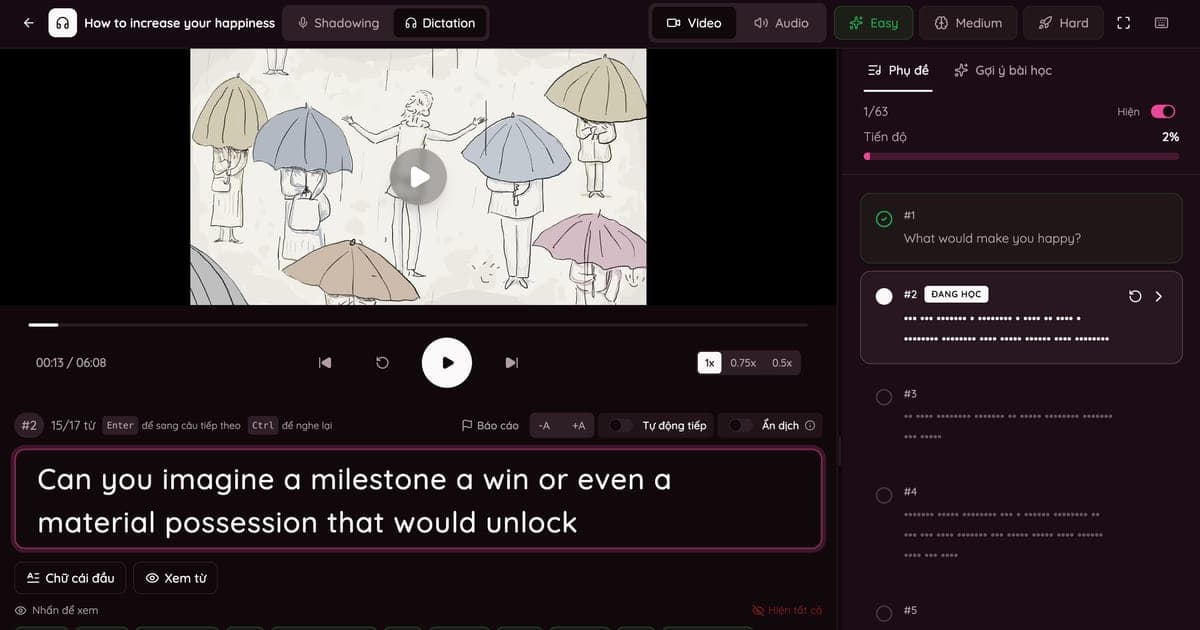
S English is an English learning app built specifically for dictation and shadowing. Instead of handing you an audio file and a transcript, it splits each YouTube video or audio lesson into short sentences: you listen, type, and every word is matched as you type. (Disclosure: S English is made by the team writing this article. We put it first because it is the only tool here that covers the whole listen, type, score and review loop in one place.)
- A library organized by topic and exam. Hundreds of dictation lessons across 12 topics, including IELTS (250+ lessons), TOEIC (100), daily conversations, business English, job interviews, travel and culture, technology and science, health and medicine, and music. Every lesson shows its CEFR level and length so you can pick the right difficulty.
- Dictation on BBC, TED and Kurzgesagt content. The famous channels further down this list are already on S English as interactive exercises: BBC Learning English (100+ lessons), TED (200+ lessons) and Kurzgesagt – In a Nutshell. You get the same quality content without pausing videos, writing on paper and checking word by word.
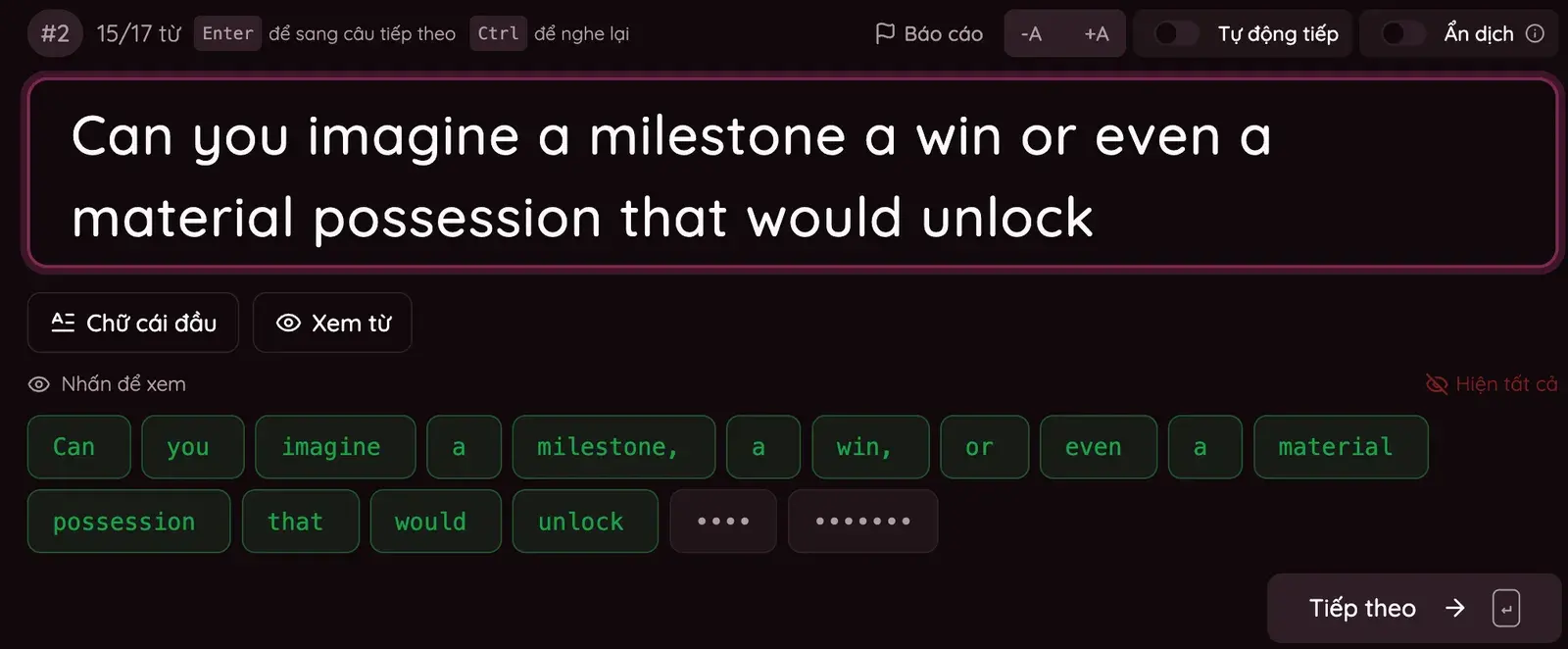
- Scoring and smart hints. Correct words light up as you type and a progress bar shows how much of the sentence you have matched. Stuck on a word? Reveal its first letter (Alt+H) or the whole word (Alt+R); for a challenge, Hard mode turns hints off. Proper nouns such as names and places are shown up front so you do not lose points on words nobody could guess.
- Keyboard-first controls. Press Ctrl to replay a sentence and Enter to move on, slow the playback down when a sentence is too fast, and switch between Video and Audio mode to focus on sound only.
- Translation and look-up inside the lesson. Each sentence has a Vietnamese translation you can hide. Click any word to see its meaning, then save the word or the whole sentence to your word list.
- Vocabulary review with spaced repetition. Saved words and sentences come back as flashcards on a spaced repetition schedule, so new words from dictation stick instead of fading after a few days.
- Switch to shadowing on the same lesson. After dictation, switch the lesson to shadowing mode to speak along with the native speaker and get AI pronunciation feedback, training listening and speaking on the same material.
- Turn your own videos into lessons. With Premium, paste a YouTube link with captions or upload your own audio (a podcast, a textbook track) and S English builds the dictation and shadowing lesson for you.
- Best for: beginners through TOEIC and IELTS candidates; anyone who wants a daily 15–20 minute routine without preparing materials.
- Limitations: you need an account to practice; some lessons are Premium.
2. BBC Learning English – the go-to source for British English
BBC Learning English is the BBC's free library of lessons, best known for 6 Minute English: two presenters discuss a news or everyday topic for about six minutes and explain the related vocabulary. There is also The English We Speak (idioms and slang), News Review (vocabulary from the news) and level-based courses.
- Strengths: standard British accent, moderate speed, downloadable transcripts for most episodes, topics close to IELTS Listening Sections 2–3.
- Limitations: no typing or scoring tool; you pause, write and compare with the transcript yourself.
- Tip: more than 100 BBC Learning English lessons are available as interactive dictation on S English.
- Best for: A2–B2 learners and IELTS candidates who want to get used to British English.
3. TED and TED-Ed – inspiring talks for intermediate learners
TED hosts thousands of talks on science, education, technology and psychology with an interactive transcript: click a line and the video jumps to that moment, which makes replaying easy. TED-Ed is its education branch, with animated videos of about 4–6 minutes, carefully scripted narration, clear pronunciation and accurate YouTube captions.
- Strengths: academic content similar to IELTS Listening Section 4; many accents, including non-native speakers; adjustable speed on YouTube.
- Limitations: TED talks usually run 10–20 minutes at natural speed, which can overwhelm beginners, and there is no dictation mode. Start with TED-Ed, which is shorter and clearer.
- Tip: S English has 200+ TED dictation lessons already split into sentences. If you like animated science explainers, try Kurzgesagt – In a Nutshell as well.
- Best for: B1 and above, IELTS candidates and anyone building academic vocabulary.
4. VOA Learning English – slower news for beginners
VOA Learning English from the Voice of America presents news in English spoken more slowly than usual, with short sentences and a limited vocabulary. Each story has audio or video plus the full text, grouped from beginner to intermediate level.
- Strengths: clear American accent, slow pace, daily updates; the text matches the audio almost word for word, which is ideal for dictation.
- Limitations: slower than real speech, so move on to natural-speed sources once comfortable; the site has many sections and finding lessons by level takes some effort.
- Best for: A1–B1 learners starting to listen to the news.
5. Breaking News English – news at 7 levels
Breaking News English rewrites current news stories as lessons at 7 levels (0 to 6). You can listen to an easier or harder version of the same story at several reading speeds, and each lesson includes a dictation activity alongside reading, vocabulary and grammar exercises.
- Strengths: completely free, built-in typing dictation, easy to step up difficulty on the same content.
- Limitations: single-voice narration with little natural conversation; dated interface and many ads.
- Best for: A2–B2 learners who enjoy learning through the news.
6. ELLLO – real conversations with speakers from many countries
ELLLO (English Listening Lesson Library Online) offers thousands of free lessons, mostly short unscripted conversations between speakers from the US, UK, Australia, Canada, South Africa, the Philippines, Japan and more. Each lesson has a transcript, comprehension questions and vocabulary notes, grouped by level.
- Strengths: natural, real-life English and a wide range of accents, great preparation for unfamiliar voices in TOEIC and IELTS.
- Limitations: recording quality varies between lessons; no dictation tool.
- Best for: A2–C1 learners who want exposure to many English accents.
7. British Council LearnEnglish – listening by CEFR level
The Listening section of British Council LearnEnglish groups lessons by level: A1, A2, B1, B2 and C1. Each lesson is a short situation (a phone call, a meeting, a lecture, an announcement) lasting a few minutes, with pre- and post-listening tasks and a transcript.
- Strengths: clear CEFR levels, test-like situations, standard British English.
- Limitations: a limited number of lessons per level; exercises are mostly multiple choice rather than dictation.
- Best for: learners who want to know their exact level and practice at it.
8. Listen A Minute – one-minute lessons
Listen A Minute offers clips of about 60 seconds on familiar topics such as sports, family, work and food, listed alphabetically. Each has a transcript, a downloadable MP3 and exercises, including dictation.
- Strengths: short and easy to keep up daily; a good 5-minute warm-up before longer practice.
- Limitations: one narrator and simple content, so advanced learners will outgrow it quickly.
- Best for: busy A2–B1 learners.
9. ESL Lab – situational conversations by difficulty
ESL Lab (Randall's ESL Cyber Listening Lab) is one of the oldest listening sites, with everyday situational conversations such as booking a room, shopping or seeing a doctor, at easy, medium and difficult levels. Many lessons include a transcript, quizzes and vocabulary.
- Strengths: realistic situations close to TOEIC Part 3 and IELTS Section 1.
- Limitations: some content is paid and the site carries many ads.
- Best for: A2–B2 learners practicing everyday conversation and TOEIC.
10. Spotlight English – slow, easy-to-follow English
Spotlight English is a radio program that explains culture, history and science topics in simple English, spoken slowly and clearly. Each episode has audio and a full transcript.
- Strengths: slow pace and clear pronunciation, ideal for beginners practicing dictation on passages longer than a minute.
- Limitations: much slower than real exams; best used early on.
- Best for: A1–A2 learners and complete beginners.
Which dictation website should you choose?
- Beginners (A1–A2): get used to slower speech with Spotlight English or VOA Learning English, and practice short, low-level lessons on S English for hints and translations when you are stuck. See also dictation for beginners.
- TOEIC preparation: use the TOEIC dictation lessons on S English as your core practice, since they follow the announcement and workplace conversation format, and add ESL Lab and ELLLO for accent variety. More in how to practice TOEIC dictation.
- IELTS preparation: combine IELTS dictation on S English, BBC Learning English and TED/TED-Ed for Sections 3–4. See dictation for IELTS Listening.
- Everyday and workplace English: pick daily conversations, job interviews and business English on S English, then switch the same lesson to shadowing to practice speaking.
- Upper-intermediate and above (B2+): listen to TED, Kurzgesagt and ELLLO at natural speed; once you transcribe more than 90% of words correctly, try Hard mode without hints on S English.
How to practice dictation online effectively
- Pick a clip slightly below your current level, 1–3 minutes long. Clips that are too hard only lead to guessing.
- Listen to the whole clip once for the main idea without typing.
- Go sentence by sentence, replay up to 3 times, and type exactly what you hear, including articles, prepositions and -s or -ed endings.
- Check against the transcript or the automatic score and mark your mistakes: misheard sounds, missed linking, or unknown words.
- Replay the sentences you got wrong until they are clear, then read them aloud a few times. This is where dictation connects with shadowing.
- Save new words and phrases and review them with spaced repetition. 15–20 minutes every day works far better than a few hours at the weekend.
On sites with only audio and a transcript you do steps 3–4 by hand. On S English, splitting, replaying, scoring and saving words are built in, so the same 20 minutes covers more sentences.
FAQ
Which dictation website is best for beginners?
Beginners should choose slow, short material with support tools: S English (low-level lessons with first-letter hints and translations), VOA Learning English or Spotlight English. Once you get more than 80% of words right, increase the difficulty.
Is there a dictation website that scores you automatically?
Yes. S English scores every word as you type and shows the match percentage for each sentence. Breaking News English and Listen A Minute have simpler typing dictation; sources such as BBC, TED and VOA only provide audio and transcripts to check yourself.
How do I practice dictation with BBC Learning English and TED?
Listen on the original site and compare your notes with the transcript, or use the BBC Learning English and TED lessons already split into sentences on S English to type and get scored instantly without pausing the video.
How long should I practice dictation each day?
About 15–20 minutes a day for a few weeks is enough for your ear to adapt to natural speed and linking. What matters is replaying wrong sentences and reviewing new words, not doing as many lessons as possible.
Can dictation replace TOEIC or IELTS practice tests?
Not entirely. Dictation trains you to hear every word, which makes tests easier, but you still need practice tests for question types and timing. A good routine is dictation every day plus one or two practice tests a week.
Practice dictation for free on S English
Hundreds of BBC, TED, TOEIC and IELTS lessons split into sentences, scored instantly, with words saved for review. Free to start.
Practice free